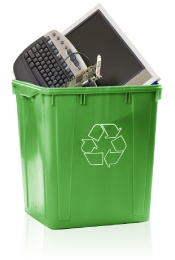
In 2013, Workday committed to a "100% no landfill policy" and we have been actively implementing this program in the last year. For example, across 4 different data centers and office locations we have conducted six hard drive collections for data destruction, shredding and recycling of materials. This accounted for a total of almost 3,000 disk drives. Similarly, over 370 units of obsolete computing equipment were collected, cleansed and made ready for resell. Recycling can even be profitable on recovery value if done right!
Workday is committed to this program on a global scale and we are extending our coverage going forward. This will ensure that we are doing our best to minimize any negative impact on the environment as outlined in our sustainability commitment.
Showing posts with label e-waste. Show all posts
Wednesday, May 7, 2014
Monday, June 10, 2013
Workday says "No" to eWaste
In order to achieve this, we have drafted an Electronics Disposition Policy which governs all handling of obsolete electronics at Workday.
The key objectives of the policy are:
- Data Safety First: Securely dispose of any data in any media in an irrecoverable way.
- Prevent Pollution: Where ever possible and environmentally sensible, equipment should be re-used internally to extend its life cycle providing value to Workday. Wherever internal re-use is not possible, opportunities for resale or donation should be pursued.
- Minimize Waste: Where re-use is not a viable option, every reasonable effort will be made to control all Electronic Wastes and to avoid Electronic Wastes from entering landfills, incinerators or entering other environmentally irresponsible processes. Environmental Partners shall contractually commit to employing environmentally responsible processes and practices in the recycling and disposal of materials. All exports and imports of Electronic Waste handled by Workday and its authorized environmental partners will comply with existing international waste trade agreements and legal requirements.
- Be a Responsible Neighbour: Workday does not permit Electronic Waste to be exported from developed (OECD/EU) to developing (non-OECD/EU) countries either directly or through intermediaries.
Sunday, January 8, 2012
Kids of Sodom - eWaste in Ghana
This year's UNICEF picture of the year is by German photographer Kai Loeffelbein. The series "Kids of Sodom" depicts life at the other end of the spectrum of consumer electronics.
If eWaste isn't just tossed into a landfill or a nearby ocean, it is collected for recycling. This sounds good, but countries are not required to recycle their electronic trash in their own country. Despite some country specific regulations or global agreements like the Basel Convention (which is not signed or ratified by all countries) this is common practice.
So each year, hundreds of thousands of tons of hazardous eWaste are shipped in containers to places like Accra in Ghana. In those countries, large slum cities exist where people try to harvest valuable materials with the poorest of means and absolutely no health protection.
Loeffelbein's photo series shows this kind of life. We are not only exploiting the poor countries for rare materials, but also toss the broken toys right back at them. With more stringent and mandatory regulation we could stop externalizing the true cost of our digital life style and achieve a more viable relationship to innovative electronics.
Labels:
e-waste,
Legislation,
Sustainability
Wednesday, November 10, 2010
Story of Electronics
Another "Story of ..." production, this time on Electronics, their "design for the dump" and the evil export of eWaste.
Wednesday, October 6, 2010
Ban on eWaste export
As we know, most of the eTrash produced in the US is not dealt with in the country, but exported to third world countries for "recycling". Which means electronics are produced in China, shipped to the US to be used for an increasingly shorter period, and then shipped back to China to drop it into a landfill. Yeah, that makes sense...
Now there is a new legislative proposal introduced to ban the export of eWaste. Read here for more details.
Friday, July 4, 2008
Thursday, February 7, 2008
Running the numbers...
Take a look at http://www.chrisjordan.com/ and run the numbers of every day consumption…some thing’s gotta be wrong around here…
You can see photos of:- 426,000 cell phones, equal to the number of cell phones retired in the US every day.
- 410,000 paper cups, equal to the number of disposal hot-beverage paper cups used in the US every fifteen minutes.
- two million plastic beverage bottles, the number used in the US every five minutes.
- 8 million toothpicks, equal to the number of trees harvested in the US every month to make the paper for mail order catalogs.
- 106,000 aluminum cans, the number used in the US every thirty seconds.
Scary, amazing art though.
Tuesday, January 22, 2008
DELL offers recycling services for old hardware
We are currently paying about 10$ per laptop or monitor as a disposal fee. This should hopefully enable us to return old and unwanted hardware to our manufacturer DELL at no cost and have them dispose of it in a safe and unharmful way.
DELL also offers this up as a full service. See http://www.dell.com/content/topics/global.aspx/services/asset_recycling/asset_recycling
in which they explain their individual services. I hope this includes not shipping the old junk abroad, but solving our first world problem on first world soil...
DELL also offers this up as a full service. See http://www.dell.com/content/topics/global.aspx/services/asset_recycling/asset_recycling
in which they explain their individual services. I hope this includes not shipping the old junk abroad, but solving our first world problem on first world soil...
Saturday, January 19, 2008
E-waste: out of sight, out of mind
Not to spoil the next iPhone, HDTV or laptop purchase, but I found a sobering (and actually depressing) article on e-waste in National Geographic:
It really makes you wonder about externalizing the costs of our high-tech infatuation. This really screams for cradle-to-cradle design…
Subscribe to:
Posts (Atom)