This year's UNICEF picture of the year is by German photographer Kai Loeffelbein. The series "Kids of Sodom" depicts life at the other end of the spectrum of consumer electronics.
If eWaste isn't just tossed into a landfill or a nearby ocean, it is collected for recycling. This sounds good, but countries are not required to recycle their electronic trash in their own country. Despite some country specific regulations or global agreements like the Basel Convention (which is not signed or ratified by all countries) this is common practice.
So each year, hundreds of thousands of tons of hazardous eWaste are shipped in containers to places like Accra in Ghana. In those countries, large slum cities exist where people try to harvest valuable materials with the poorest of means and absolutely no health protection.
Loeffelbein's photo series shows this kind of life. We are not only exploiting the poor countries for rare materials, but also toss the broken toys right back at them. With more stringent and mandatory regulation we could stop externalizing the true cost of our digital life style and achieve a more viable relationship to innovative electronics.
Showing posts with label Legislation. Show all posts
Sunday, January 8, 2012
Sunday, December 18, 2011
COP17 and the meaning of global climate politics
In our series of review posts on Climate Change Conferences (see COP15/Copenhagen and COP16/Cancun), we have to take a look at what was achieved in Durban as part of COP17 in the first weeks of December 2011.
Let's keep in mind that the currently active agreement for stabilizing green house gas emissions globally, the 1997 Kyoto protocol, is running out in 2012. No binding successor agreement is in place and finding a solution to this problem was the primary purpose of COP17 (and its predecessors).
The conference was off to a slow start and nothing much was achieved until the very last days. In fact, the real action took place after the main event had concluded. In 2 night long sessions, an agreement of some form was reached after all. Here is the high level summary:
Kyoto and its followers
Green Climate Fund
Establishing a central fund aimed at transferring investment for sustainable energy development to the more impacted poorer countries is a good idea. There is certainly lots to outline on how such a fund would be structured and managed. But given the current economic weakness and respectives debt crisis of the EU and US, it remains highly doubtful when and if such a fund would be filled with investment money.
CCS
Given the high percentage of coal-based energy generation, it seemed logical to pursue a technology to separate the carbon from the power plants' emissions and store it somewhere. Such technology exists in an exploratory stage, but there is no proof that it can play any role on a larger scale to reduce CO2 emissions worldwide. The amounts of CO2 would be staggering and require entire underground cave structures, all to be used for thousands of years without leakage. There is no company or country that can guarantee that such a process could work and therefore making CCS part of a climate treaty is highly questionable.
REDD
The rampant deforestation is an irreversible process that is extremely harmful to the CO2 balance. Pushing for active reduction of this emission source by creation of a strong framework is very meaningful and can take effect directly without large technology or investment risk. It should be put into place immediately.
So, overall, COP17 was not the complete failure it threatened to be, but also it showcased the difficulty of any global consensus building that involves painful restrictions and financial burdens to be placed on the developed countries. It remains to be seen if a clear roadmap for the 2020 agreement can be developed in the next three years and if it can be put into effect in a truly binding way at all.
Let's keep in mind that the currently active agreement for stabilizing green house gas emissions globally, the 1997 Kyoto protocol, is running out in 2012. No binding successor agreement is in place and finding a solution to this problem was the primary purpose of COP17 (and its predecessors).
The conference was off to a slow start and nothing much was achieved until the very last days. In fact, the real action took place after the main event had concluded. In 2 night long sessions, an agreement of some form was reached after all. Here is the high level summary:
- The Kyoto protocol will be extended to a second commitment period until the end of 2017.
- A new legally binding agreement will be defined by 2015 and put in place by 2020.
- A rough outline of the Green Climate Fund, aiming at bringing financial aid from developed countries to poorer nations, was sketched. The actual funding remains unclear.
- More efficient market mechanism for handling carbon emissions were discussed.
- CCS (Carbon Capture and Storage) has been anchored in the agreement as a climate saving technology.
- Further steps on REDD (Reduced Emissions from Deforestation and Degradation) have been outlined.
Now, what does this all mean? Here are some reflections.
Kyoto and its followers
Overall, we have to openly question the efficiency of a global treaty such as the Kyoto protocol. The US, as the 2nd largest emitter of CO2, never ratified it. China, the largest emitter of CO2 by now, is classified as a developing country and does not have to commit to specific targets. Even better, right after Durban closed, Canada announced that they will withdraw from the treaty altogether since it would impose economic hardship on the country. So what good does it really do? It remains highly questionable if we can ever reach a centrally organized treaty that transfers into binding country law to reduce emissions. Such a centralized, top-down approach seems politically naive and will never reach the dramatic positive impact we need. It will be undermined by the existing economic and political lobbies in each country and at best limp along in slow motion.
Green Climate Fund
Establishing a central fund aimed at transferring investment for sustainable energy development to the more impacted poorer countries is a good idea. There is certainly lots to outline on how such a fund would be structured and managed. But given the current economic weakness and respectives debt crisis of the EU and US, it remains highly doubtful when and if such a fund would be filled with investment money.
CCS
Given the high percentage of coal-based energy generation, it seemed logical to pursue a technology to separate the carbon from the power plants' emissions and store it somewhere. Such technology exists in an exploratory stage, but there is no proof that it can play any role on a larger scale to reduce CO2 emissions worldwide. The amounts of CO2 would be staggering and require entire underground cave structures, all to be used for thousands of years without leakage. There is no company or country that can guarantee that such a process could work and therefore making CCS part of a climate treaty is highly questionable.
REDD
The rampant deforestation is an irreversible process that is extremely harmful to the CO2 balance. Pushing for active reduction of this emission source by creation of a strong framework is very meaningful and can take effect directly without large technology or investment risk. It should be put into place immediately.
So, overall, COP17 was not the complete failure it threatened to be, but also it showcased the difficulty of any global consensus building that involves painful restrictions and financial burdens to be placed on the developed countries. It remains to be seen if a clear roadmap for the 2020 agreement can be developed in the next three years and if it can be put into effect in a truly binding way at all.
Labels:
Climate Crisis,
Legislation
Sunday, December 12, 2010
A good day in Cancun
For the last 2 weeks, the world's climate-concerned eyes have been on Cancun where the UNFCCC met to improve on the failure of the Copenhagen conference. Not much hope was had going into the conference, too many contentious issues were raised before the conference even began. But last night, a compromise was reached and the conference ended with a positive outcome that sets the framework for future more binding agreements as a follow-up to the Kyoto protocol.
In short, the Cancun Agreements entail the following:
- Establishing a formal temperature target of 2 degrees Celsius above pre-industrial levels.
- A commitment to REDD (Reducing Emissions from Deforestation and Forest Degradation) to include the protection of rain forests into the climate protection measures. Most importantly reduced deforestation can count as an offset in a cap-and-trade system.
- A framework for to measure, record and verify (MRV) emissions that can includes industrialized and non-industrialized countries.
- A structure for a "green climate fund" which will contain the 100$ billion committed annually during Copenhagen. This fund will be critical to fund investments in clean energy in the emerging countries.
While no hard commitments were set yet by any countries and the emergence of national agreements that support this direction are to be formed, this conference is a major step forward and proves that the UNFCCC can function as a body to govern climate policy.
It also shows that one person can make a big difference. Mexican Foreign Minister, Mrs. Patricia Espinosa, skillfully led the entire conference and when Bolivia threatened to kill the unanimous vote required for an agreement, she duly noted the concern and made a result happen. Her leadership has restored faith in the difficult multilateral process of climate talks. Sometimes politicians actually can be climate heroes...
Some relevant commentary and links:
Labels:
Climate Crisis,
Legislation
Wednesday, October 6, 2010
A fight worth having
California has led the country in clean energy legislation by introducing A.B. 32, a forward-looking bill supported by all parties. Unlike the political stalemate on the Federal level, California achieved landmark legislation and this is even more important with this year's missed opportunities for a country-wide or global regulation. Many things that started in California have changed the world for the better!
Now, with Prop 23, out of state oil companies are trying to gut this legislation by tying it to an unrealistic level of unemployment. This even infuriated Gov. Arnold Schwarzenegger (Rep), a long time proponent of A.B.32. Read more about it in Friedman's recent column.
So, what can you do?
- Get informed by visiting "No on Prop 23".
- Learn what A.B. 32 does for California.
- Tell your friends on Facebook about it.
All very confusing? Just remember: A.B. 32, good; Prop 23, bad.
Wednesday, February 17, 2010
SEC issues guidance on carbon disclosure
While not a binding law on how companies need to report on carbon, the SEC has now issued guidance on how corporations should disclose their climate impact. I would see this as step in the right direction of more formal and binding disclosure coming soon.
Read more about the SEC statement here.
Another one to watch for carbon disclosure is the Carbon Disclosure Project (CDP).
Read more about the SEC statement here.
Another one to watch for carbon disclosure is the Carbon Disclosure Project (CDP).
Saturday, January 9, 2010
COP15 thoughts
Ok, since every green blogger on the planet has been pouring his or her frustrated heart out about what went down in Copenhagen in December of 2009, here is my therapeutic attempt.
The goal going in was to negotiate a successor agreement to the expiring Kyoto protocol. So, stakes were high and positions could not have been more different on the individual issues. Small and developing countries have a lot to lose by climate change; large and rich(er) countries contribute most to the problem, but also have to spend the most money to fix the problem. Not an easy negotiation task.
But it all fell apart in the process. Lots of reasons, lots of blame, but here are views of COP-15 that I found worth reading:
- Carl Pope of Sierra Club: Lessons from Denmark
- Steve Howard of the Climate Group: The Copenhagen Accord
Next preparation summit is mid-year in Germany with a target of another meeting in Mexico in 2010. Maybe that will go better, it certainly needs to...
The goal going in was to negotiate a successor agreement to the expiring Kyoto protocol. So, stakes were high and positions could not have been more different on the individual issues. Small and developing countries have a lot to lose by climate change; large and rich(er) countries contribute most to the problem, but also have to spend the most money to fix the problem. Not an easy negotiation task.
But it all fell apart in the process. Lots of reasons, lots of blame, but here are views of COP-15 that I found worth reading:
- Carl Pope of Sierra Club: Lessons from Denmark
- Steve Howard of the Climate Group: The Copenhagen Accord
Next preparation summit is mid-year in Germany with a target of another meeting in Mexico in 2010. Maybe that will go better, it certainly needs to...
Labels:
Climate Crisis,
Legislation
Saturday, June 27, 2009
One step closer - ACES passes house...
As posted recently, there is major green legislation underway in the form of the American Clean Energy and Security Act 2009.
Yesterday, this bill passed the House of Representatives with a narrow margin. While this is big news for all things green, there are still substantial hurdles before this legislation opens up a green energy future. Stay tuned and get engaged to make this happen.
Next stop Senate and then ready for the Copenhagen treaty...
Yesterday, this bill passed the House of Representatives with a narrow margin. While this is big news for all things green, there are still substantial hurdles before this legislation opens up a green energy future. Stay tuned and get engaged to make this happen.
Next stop Senate and then ready for the Copenhagen treaty...
Sunday, April 26, 2009
Committee hearings underway!
A week ago the most important piece of US climate legislation ever has been submitted for review. The congressmen Henry Waxman and Ed Markey have submitted a draft of the American Clean Energy and Security Act 2009. This bill aims to cut U.S. greenhouse-gas emissions by 83% compared to 2005 levels by 2050. That’s the same target President Obama has, but the House bill sets more aggressive short-term targets, such as a 20% reduction by 2020 and a 42% cut by 2030. It is a critical mechanism to implement a full blown cap-and-trade agreement.
Given that this 600 pager is a pretty substantial piece of legislation and is planned to pass all hurdles in this year, big discussion ensues. The Energy and Commerce Committee is reviewing this bill in many hearings, which you can follow in the Sierra Club life blog named "broken record".
Legislation will be the most important mechanism to avoid a severe climate crisis in the next 30-50 years. The USA will be the critical country to initiate and drive the change to a sustainable future. Whatever is going to happen in congress this year will set the tone for the UN climate conference in Copenhagen in December this year. This is where the expiring Kyoto protocol is renegotiated and the role of the US will be driving responses from China, India and all other countries.
I recommend following these debates and check out groups such as RepowerAmerica, WeCanSolveIt, Environmental Defense Fund or the Sierra Club...
Given that this 600 pager is a pretty substantial piece of legislation and is planned to pass all hurdles in this year, big discussion ensues. The Energy and Commerce Committee is reviewing this bill in many hearings, which you can follow in the Sierra Club life blog named "broken record".
Legislation will be the most important mechanism to avoid a severe climate crisis in the next 30-50 years. The USA will be the critical country to initiate and drive the change to a sustainable future. Whatever is going to happen in congress this year will set the tone for the UN climate conference in Copenhagen in December this year. This is where the expiring Kyoto protocol is renegotiated and the role of the US will be driving responses from China, India and all other countries.
I recommend following these debates and check out groups such as RepowerAmerica, WeCanSolveIt, Environmental Defense Fund or the Sierra Club...
Saturday, April 11, 2009
Carbon Accounting - an opportunity for Workday?
In a recent InfoWorld article, the crucial role of IT in the solving the climate crisis is described in two dimensions:
* measuring CO2 emissions
* reducing the carbon footprint of enterprises
With a cap-and-trade agreement drawing closer and closer, the need to measure the emissions is very clear. Lots of companies will look for ways to comply to the new regulations and an assessment of their current footprint will become an immediate requirement. Several companies are starting to offer solutions already. Some might be rudimentary, but the concept is there. Note that several of these companies are already in the Workday eco-system:
* ILOG (our Flex graphics provider)
* Rackspace (our online email provider)
* Microsoft (strategic partner)
More comprehensive solutions are being worked on by interesting startups such as Greenstone.
The reduction of CO2 emissions of an enterprise can be accomplished in a wide variety of ways. The SaaS delivery model with its highly efficient hosting environments provides a good way to reduce IT-based emmissions. Workday plays a very positive role in this dimension already. Our customers can turn off their on-premise servers and rely on our data centers. Carbon offsets for our energy consumption could complete the footprint reduction for our customers.
But how about the measurement dimension? Workday already is the system of record for all accounting activity, why not carbon accounting? Could integration to upcoming hosted carbon-measurement systems make a difference? Is there a strategic opportunity for us to pursue?
The Microsoft environmental dashboard extension is an interesting data point. Warren Wilson, research director with London-based market researcher Ovum, said other major ERP vendors, including SAP and Oracle, as well as smaller players are building a range of tools to measure carbon emissions. I had a phone call with Warren about 9 months ago where was inquiring about Workday's interest in this topic. I believe our interest could be sparked by the increasing market demand.
* measuring CO2 emissions
* reducing the carbon footprint of enterprises
With a cap-and-trade agreement drawing closer and closer, the need to measure the emissions is very clear. Lots of companies will look for ways to comply to the new regulations and an assessment of their current footprint will become an immediate requirement. Several companies are starting to offer solutions already. Some might be rudimentary, but the concept is there. Note that several of these companies are already in the Workday eco-system:
* ILOG (our Flex graphics provider)
* Rackspace (our online email provider)
* Microsoft (strategic partner)
More comprehensive solutions are being worked on by interesting startups such as Greenstone.
The reduction of CO2 emissions of an enterprise can be accomplished in a wide variety of ways. The SaaS delivery model with its highly efficient hosting environments provides a good way to reduce IT-based emmissions. Workday plays a very positive role in this dimension already. Our customers can turn off their on-premise servers and rely on our data centers. Carbon offsets for our energy consumption could complete the footprint reduction for our customers.
But how about the measurement dimension? Workday already is the system of record for all accounting activity, why not carbon accounting? Could integration to upcoming hosted carbon-measurement systems make a difference? Is there a strategic opportunity for us to pursue?
The Microsoft environmental dashboard extension is an interesting data point. Warren Wilson, research director with London-based market researcher Ovum, said other major ERP vendors, including SAP and Oracle, as well as smaller players are building a range of tools to measure carbon emissions. I had a phone call with Warren about 9 months ago where was inquiring about Workday's interest in this topic. I believe our interest could be sparked by the increasing market demand.
Labels:
Climate Crisis,
Datacenter,
Legislation,
SaaS
Monday, January 26, 2009
Starting the change
Today president Obama took real action on climate change. He revoked a Bush statement that was restricting states like California to pass stricter emission laws for cars. The days of Washington dragging its heels are truly over!
Read more and see the announcement here.
p.s. i just looove typing "president OBAMA" - it's so awesome...
Read more and see the announcement here.
p.s. i just looove typing "president OBAMA" - it's so awesome...
Sunday, December 21, 2008
Making sure the damage lasts...
The current administration might leave us with a terrible good-bye present. Head of the EPA Stephen Johnson has recently announced that despite his earlier stance he does not consider carbon dioxide a pollutant to be regulated when approving power plants. This impacts the construction of several large coal power plants that are pending this decision. We are talking about 10-12 new large coal power plants producing 8000 megawatts of energy.
This is exactly the kind of outdated argumentation and legislation which will hinder any advances in renewable energy sources. And they are just trying to sneak it in in the last days of old thinking. Read more on it here.
Labels:
Energy,
global warming,
Legislation
Wednesday, December 17, 2008
New energy secretary is green
This is excellent news: Obama appointed Steven Chu, Nobel physics laureate and former top federal environmental regulator as energy secretary. This is a strong signal that the new Administration will push for Renewable Energy!
Read about it here.
Read about it here.
Sunday, December 7, 2008
Climate Action Report 2008
The Climate Action programme, an international organization aimed to help governments and companies to reach their climate goals, has posted their latest Climate Action Report 2008.
This free online report offers lots of interesting articles on legislation, technology, finance and other related categorizes. Go take a look...
Labels:
Climate Crisis,
Green Business,
Legislation
Saturday, November 29, 2008
Governors' Global Climate Summit
On November 17/18, CA Governor Arnold Schwarzenegger invited world leaders for a 2-day summit to drive concrete action plans for fight the climate crisis.
As you know, under Schwarzenegger California passed the visionary AB32 climate act in 2006 and this is a next step towards real measurable change. The hope is that this prepares a new Global Climate treaty to be signed in Copenhagen in 2009. This should extend and exceed the Kyoto protocol and will hopefully be signed by all nations.
Check out all the content and videos on the summit site....
As you know, under Schwarzenegger California passed the visionary AB32 climate act in 2006 and this is a next step towards real measurable change. The hope is that this prepares a new Global Climate treaty to be signed in Copenhagen in 2009. This should extend and exceed the Kyoto protocol and will hopefully be signed by all nations.
Check out all the content and videos on the summit site....
Labels:
Climate Crisis,
Legislation
US Energy Mix - can we change it?
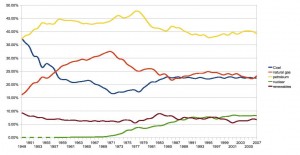
Here is an interesting chart in the development of the US energy mix since the 50s.

(Source: EAI)
Renewables clock in at about 7% only. Given the massive energy requirements of the US, it will be quite a ways before this can be covered by wind, solar, etc. But you can also see the incredible amount of carbon-producing sources we are burning through.
Now compare this to the world energy consumption per capita. There is a strong relationship between wealth and energy consumption:

So how much would a change in US energy policy matter? Well, the 5% of the world's population that lives in the U.S. has more environmental impact than the 51% that live in the other five largest countries. Quite an extraordinary leverage (an imbalance)...
(Source: EAI)
Renewables clock in at about 7% only. Given the massive energy requirements of the US, it will be quite a ways before this can be covered by wind, solar, etc. But you can also see the incredible amount of carbon-producing sources we are burning through.
Now compare this to the world energy consumption per capita. There is a strong relationship between wealth and energy consumption:
So how much would a change in US energy policy matter? Well, the 5% of the world's population that lives in the U.S. has more environmental impact than the 51% that live in the other five largest countries. Quite an extraordinary leverage (an imbalance)...
Labels:
Climate Crisis,
Energy,
Legislation
Friday, November 28, 2008
Germany reaches Kyoto commitments
In a recent study Germany disclosed that it reached it Kyoto protocol goals this year. in 1997 it was agreed to lower CO2 emissions below the level of 1990 by the year 2012. Germany has met this goal 4 year ahead of schedule.
This covers emissions from private households, transportation, energy production and other areas. It shows that it can be done without economic impact. Hopefully the USA joins the planned follow-up agreement....
Labels:
Climate Crisis,
Legislation
Friday, November 14, 2008
Now's the time...
According to a recent poll, 2/3 of the Americans think that now is the time to act on the climate crisis and create economic stimulus by investing in renewable energy.
A few of the other poll highlights include:
- 78% of voters think it is very or somewhat important to address the problems of global warming and climate change, while 22% do not.
- 35% of voters think it is most important for Congress to pass a plan that creates new jobs by investing in renewable energy projects. This compares with 26% who said expanding health care coverage is most important and 23% who said regulating the financial services industry should be the top priority.
- 50% of voters said that our oil addiction and economic problems are linked and should be dealt with together, compared with 26% who said we must deal with our oil addiction now and only 13% who said we should deal with our economic problems first.
Wednesday, October 1, 2008
Arnie to the rescue
California is leading the way with regulations to avert the climate crisis and Governator Arnold Schwarzenegger is putting together a summit for all states to make progress on this...he said he is tired of waiting for Washington. Go Arnie!
Read the details here...
Sunday, June 29, 2008
California leads the way
The state of California has always been a leader in green legislation and the CARB (California Air Resource Board) has now released a draft of Assembly Bill 32 (AB32).
This truly forward-thinking regulation of 2006 calls on California to reduce its greenhouse gas emissions to 1990 levels by 2020. This will be done by gradually reducing the amount of allowed emissions as well as a cap-and-trade system. Utilities will produce a third of their energy from renewable sources, clean cars will be mandated, solar heating for houses will be the norm.
With legislation in place, technology and businesses now can rise to the challenge of meeting the set goals. There is so much we can do, this shows the way...
This truly forward-thinking regulation of 2006 calls on California to reduce its greenhouse gas emissions to 1990 levels by 2020. This will be done by gradually reducing the amount of allowed emissions as well as a cap-and-trade system. Utilities will produce a third of their energy from renewable sources, clean cars will be mandated, solar heating for houses will be the norm.
With legislation in place, technology and businesses now can rise to the challenge of meeting the set goals. There is so much we can do, this shows the way...
Subscribe to:
Posts (Atom)